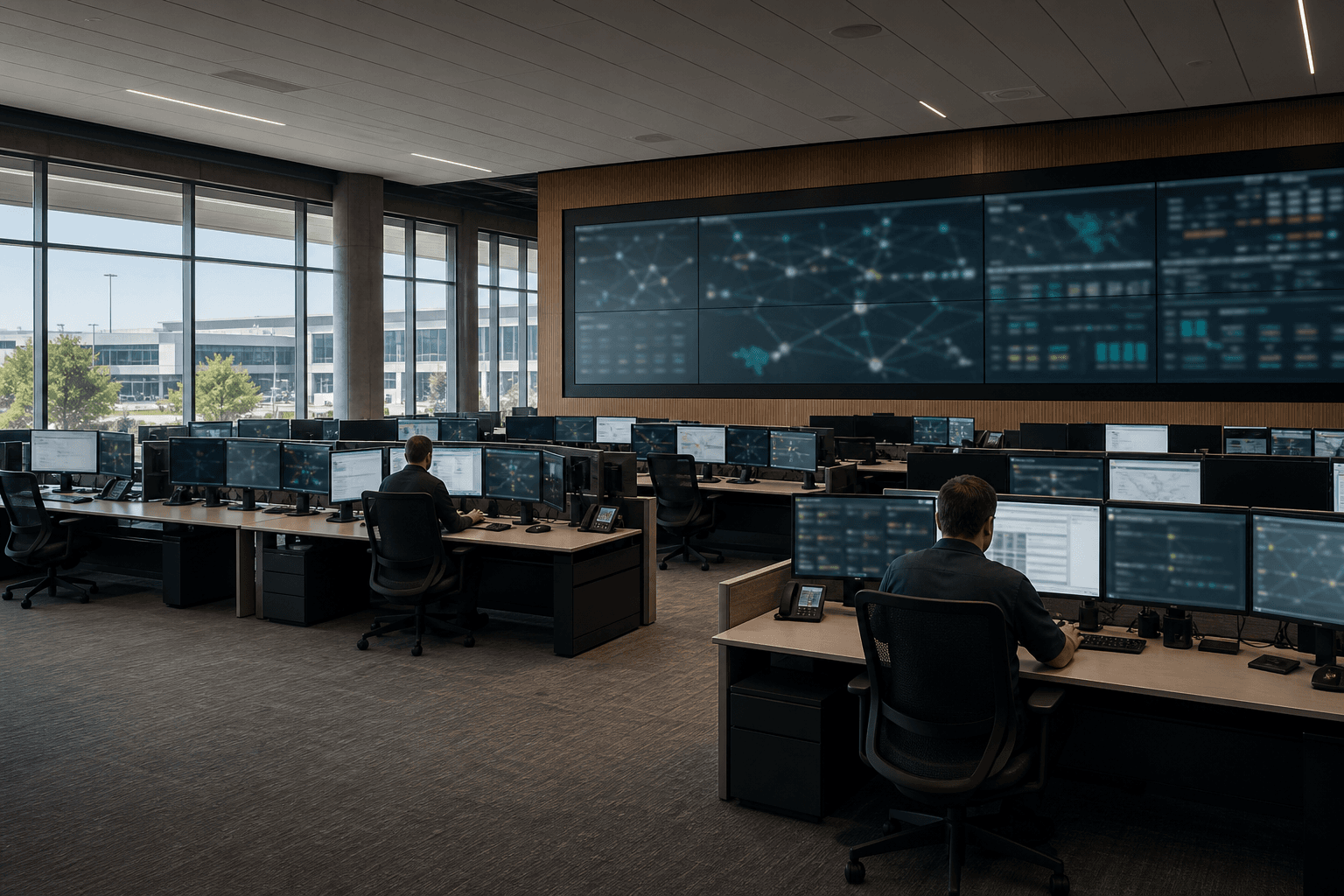
Two adjacent patterns combined: (a) predictive maintenance for BHS, jet bridges, HVAC, runway lighting fed by IoT sensor data, and (b) AOC disruption-management agentic decision support: multi-stakeholder reasoning across irregular operations, weather diversions, gate reassignments, crew/aircraft constraints. Most LATAM hub airports lack this; the few that have it cite 30–40% reductions in unplanned downtime and maintenance cost.
Buyer · COO of the airport authority + Director of Maintenance + AOC lead + airline operations counterpart.
Provenance tiered explicitly. Audited > Operator-disclosed > Vendor-published. Treat all vendor-tier figures as directional.
Multi-stakeholder reasoning is the agent-native problem. Irregular operations span airline, handler, security, customs, concession, and ground transport, and the value is in synthesizing across them, not in any single subsystem.
Stakeholder coordination is the binding constraint. SITA's diagnosis of "data fragmentation" is most acute here. Procurement cycles are 18–36 months. The "airport brain" / "single pane of glass" pitches have a long history of collapse: this category has been over-marketed and under-built.
AICM's operational caps and AIFA-driven market shifts plus the US DOT antitrust-immunity dispute with Aeroméxico/Delta JV make Mexican aviation operationally turbulent, meaning any working AOC-side AI has outsized value. Cancún (ASUR) and Monterrey (OMA) are the natural anchor candidates given their scheduled capital cycles.
Each node maps to a regulatory anchor.
- 01Stakeholder data: airline, handler, security, customs, weather, concession, ground transport
- 02State synthesis: current ops + forecast + constraints
- 03Agent recommendation per scenario, with explicit constraints and trade-offs
- 04Per-stakeholder approval routing (one gate per stakeholder)
- 05Execution + measurement: gate utilization, baggage, OTP, recovery time
- 06Post-event review with stakeholder-by-stakeholder learning
Not "The airport brain." "Single pane of glass." A multi-year transformation.
But Agentic decision support for one named scenario at one named hub, measured against one hard KPI, expanded only after the first scenario validates.
Early deployments fail when the airport tries to roll out cross-stakeholder reasoning without securing one airline partner first. The fix is to start with a single airline at a single hub on a single scenario; afternoon-thunderstorm diversion at Cancún is the cleanest first scenario.
A working session, not a sales call.
Two hours with a partner. Your incumbent stack, your data posture, and the regulatory surface against a sovereign reference architecture for aviation.
Request a working session →A working session, not a sales call.
Two hours with a partner. We map your AI spend, data exposure, and governance posture against a sovereign reference architecture. You leave with a memo. We leave with a decision.